

Three Grains of Rice
Read a new short story from Josh Reynolds featuring the Scorpion Clan’s Bayushi family
To celebrate Edge Studio’s recent release of Hand of Secrets for the Legend of the Five Rings roleplaying game, we bring you the first of a new and exclusive series of Tales of the Scorpion Clan from Aconyte Books.
“Three Grains of Rice” by Josh Reynolds highlights the machinations spun by the Bayushi family of the Scorpion Clan. The Bayushi have cultivated a reputation for villainy, harnessing the other clans’ fear of them in their service to the Emerald Empire as a whole. They manipulate, they lie, and they coerce in the name of duty and loyalty.
Read or listen below and sign up for the Legend of the Five Rings newsletter and subscribe to the Aconyte Fiction Podcast to make sure you catch the rest of the series.
Bayushi Isamu was bored.
This was not an unusual state of affairs. The work of a Scorpion Clan trade envoy was tedious at the best of times and mind-numbingly maddening at the worst. Today was the latter. He knelt before a low writing desk, piled high with invoices, requests for intervention, and various other pieces of correspondence. None of it was particularly pressing, but he felt no temptation to ignore any of it. It would only take one misspent day to render the pile unmanageable.
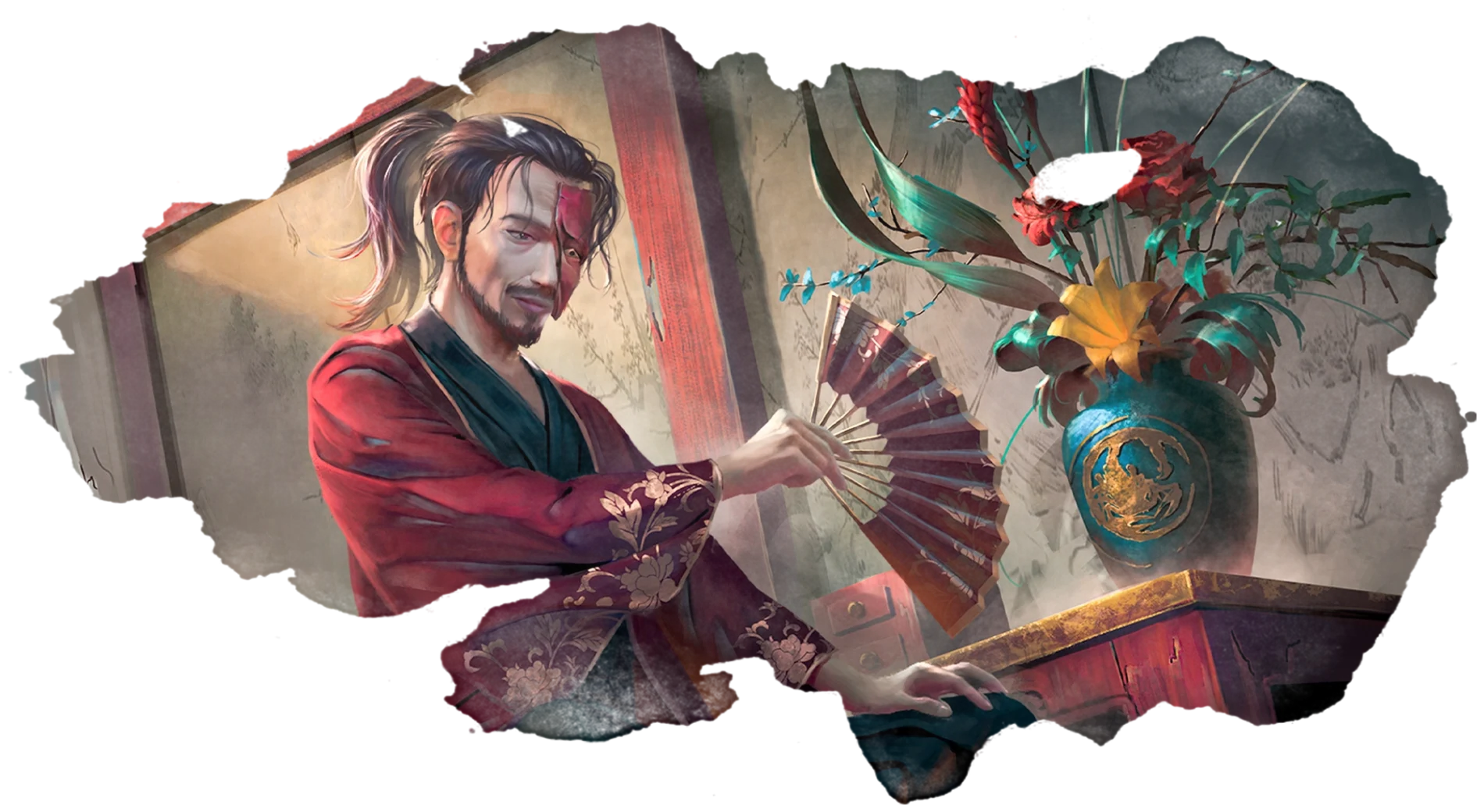
After what felt like hours, Isamu stood and stretched, grunting as something in his back popped. He was a slim man, on the steady ascent towards middle age, but still graceful. He wore robes of black, red, and gold with vibrant embroidery on the hems, and a tasteful veil hid the lower half of his face. He wore his hair loose, save for a golden, scorpion-shaped band that kept it out of his eyes. Still trying to ease the incipient ache in his back and shoulders, he made his way to the open doors of his balcony and stepped out into the muggy warmth of the noonday sun.
Outside, the City of the Rich Frog staggered under the oppressive weight of the summer heat. The shallows of the Three Sides River had become muddy wallows as the water level dropped, and traffic diminished accordingly. Even so, commerce continued unabated. Merchants schemed; traders prevaricated. Koku changed hands at expected levels. This last was the most important, from Isamu’s point of view.
Money, like the river, could be both a source of life and a cause of death. So long as it flowed as predicted, stability was assured. But the influx of too much money, or its sudden, unplanned withdrawal from the local economy, could lead to volatility in both the region and the empire as a whole. Not just financial, but political and social.
In that regard, the City of the Rich Frog was regarded as an economic bellwether for the empire as a whole – a predictor of future trends, as well as future problems. If something were happening, it would start here.
At least, that was the theory. Isamu, who had been a resident for nearly three years now, was beginning to doubt that the city held any importance in the grand scheme of things. In his opinion, it was a provincial slum, significant only in that it was a well-gnawed bone of contention between three Great Clans. But others, much higher in the hierarchy of both the Bayushi family and the Scorpion Clan, disagreed. Thus, Isamu had been dispatched, ostensibly to oversee the interests of his clan in the area, but also to keep watch – just in case. A great responsibility, and a high honor.
Isamu could have happily done without either.
A polite cough from the other side of the study door alerted him to the presence of his manservant, Hiku. “Enter,” Isamu called out, and the door slid open with a slight rattle. Hiku bowed low, his bald head dappled with a faint sheen of perspiration, and his elongated earlobes wiggling as he spoke. He was short and overweight; round like a dumpling.
“Your afternoon appointment is here, my lord,” Hiku murmured. Although he wore no mask, his expression was usually fixed in a benign smile that might as well have been one. Isamu sighed.
“Oh joy. How I have longed for this moment.”
“My lord?” Hiku asked, head tilted quizzically.
Isamu gestured in dismissal. “Never mind. Send them in, if you would.”
“Of course, my lord. Shall I prepare tea?”
“No. They won’t be staying long.”
Hiku bowed again and shuffled out. Isamu remained on the balcony and waited for his guests. His study doubled as a receiving room; a pragmatic soul, Isamu saw no reason to set aside a special room for guests, especially since so few of them stayed more than the length of a single conversation. Ostentation, and its lack, were both useful tools when it came to dealing with guests.
Especially guests like these.
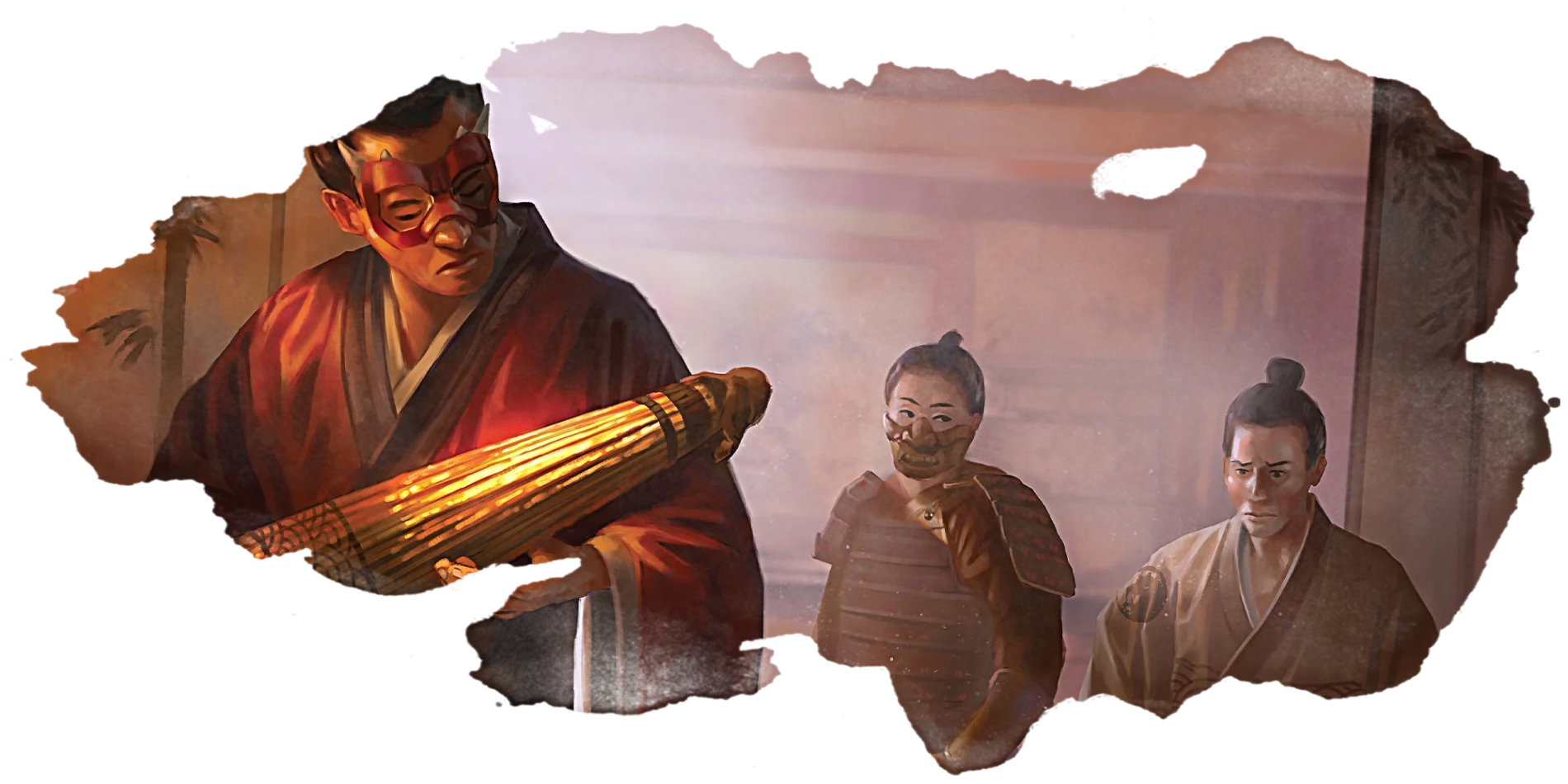
Two men appeared at the doorway a moment later and abased themselves as was only proper. Both were dressed simply, but tidily, as befitted men of low rank. One man was clad in red and black, and the other in robes the color of sun-weathered stone. The former was named Genki, the latter, Hosatsu.
Genki was ugly. Hosatsu was old. These were their defining qualities, as far as Isamu was concerned. Both men were merchants; neither was of particular importance. They were merely pieces on the game board that was the city.
Genki was a vassal of the Bayushi family, a grain dealer of dubious reputation, infamous throughout the city for his prominent collection of unsightly boils. Some vassals took to wearing masks in imitation of their patrons. Genki had no need of a mask, given the growths on his face, though many, Isamu included, wished he would take to wearing one. Genki, despite his unpleasant appearance, was a useful tool. At times, he acted as an informant and spy. At other times, he could be used to set certain events in motion.
Hosatsu was also a vassal, in his case of the Akodo family, though he thought no one knew it. Some merchants preened and showed off their patrons, using the borrowed influence to elicit custom. Genki was one of these. Others tried to maintain the pretense of their independence, for a variety of reasons. Hosatsu was of the latter variety; in other words, a spy, and a better one than Genki. But not so good as to escape Isamu’s notice.
Isamu studied both men in silence. To speak first was to cede ground; any child knew that. So, he waited, and gave no sign of his impatience.
Genki, who knew the game, held his tongue. Hosatsu, who didn’t, yielded to the temptation and said, “Might I ask why I am here, my lord?” The old man had a rough, gravelly voice, as if his throat had been injured at some point in the past.
On the battlefield, I expect, Isamu thought.
“You have made a complaint to the Kaeru Trade Bureau,” Isamu said, indicating Genki. “As the complaint was directed at my vassal, I was asked to arbitrate the matter.”
“That hardly seems fair,” Hosatsu said.
Isamu inclined his head. “And yet, the request was made and I have agreed. State your case, and I will do my best to deliver a fair verdict.”
“He is a thief and liar,” Hosatsu said, firmly. “He undersold and overcharged me for a shipment of rice.”
“Three grains,” Genki said, in protest. “Three grains, no more than that!”
“Much more than that,” Hosatsu retorted. “Three grains for every five, by my estimates. That accounts for a substantial amount of rice, my lord.”
“And how did you determine this?” Isamu asked, smoothly.
Hosatsu frowned. “I weighed it, my lord. As I always do.”
“Who weighs rice?” Genki spat.
“Merchants who wish to remain in business,” Hosatsu growled, turning to face Genki, who bristled in anger. Isamu held up a hand, forestalling any further retorts.
“And has this occurred before?” Isamu asked.
Hosatsu hesitated. “No.”
“A first offense, then. An accident?”
“Intentional,” Hosatsu replied. Genki started to speak, but Isamu cut him off again.
“And how do you know this?”
“He admitted it!”
“I did no such thing,” Genki snarled. “I merely inquired as to why it mattered!”
“I paid–” Hosatsu began, but Isamu silenced him with a look. He switched his gaze to Genki, who shrank back, seemingly startled.
“And why did you phrase it thus, Genki?”
“He’s selling to the Akodo,” Genki said, after a moment. “Not directly, but everyone knows it. What do they need with so much rice?” He smiled uncertainly, seeking Isamu’s approval. Isamu gave him a slight nod, and Genki beamed.
“A good question,” Isamu allowed. He turned a slow, unblinking gaze on Hosatsu. To his credit, the old man didn’t flinch. Nerves of iron, Isamu thought. “Well, Hosatsu? Why do the Akodo need so much rice?”
Hosatsu raised his chin. “I do not sell to the Akodo. I sell to other vendors. Who they sell it to is their concern, not mine.”
“Yes… and these vendors would be the merchants Aramaki, Fusha and Gorai; all three being Akodo vassals, and quite proud of it.” Isamu ticked off each name on his fingers as he spoke. Genki blinked in apparent amazement at these revelations. Hosatsu did not so much as flinch. “Furthermore, you split the rice shipment which Genki delivered into three smaller shipments, and sold each on, at a significant loss to yourself. Tell me again about merchants who wish to remain in business. Better still, tell me why the Akodo need so much rice.”
“A dry summer foretells a lean winter,” Hosatsu said, piously. Isamu waved this bit of peasant wisdom aside.
“Yet you have been doing this for nearly two years and as I recall, last summer was quite wet. So, I ask again: why are you selling so much rice, at a loss, to the men I have named?”
Hosatsu said nothing. It might as well have been a confession. Isamu nodded, as if Hosatsu had answered his question. “As I thought. Genki – you may leave us.”
“My lord?” Genki looked confused.
“You have played your part admirably, but your countenance repulses me. I have had all I can stand of your face. Go, with my compliments.”
Genki bowed jerkily and hurried out. It was hard to tell, given the state of him, whether he was upset by Isamu’s insult, or merely relieved to be leaving. Isamu didn’t particularly care either way. His attentions were fixed on Hosatsu.
“You told him to short me on the rice,” the old man grunted. Isamu smiled, pleased by his guest’s quick wit. It boded well for the future.
“I did.”
“Why?”
“Isn’t it obvious? I knew that you would complain, and I wished to speak with you, to discuss this matter in private.”
“There is nothing to discuss, my lord. Who I sell rice to is my concern.” Hosatsu straightened as he said it, as if readying himself to receive a blow. Isamu frowned.
“With all due respect, it is also my concern, when it is my rice. Now, one might argue that it ceases to be mine when it is sold, but I find that to be a specious argument. The rice is mine, and where it goes is my business – as is what it is used for.”
“It’s going to feed people,” Hosatsu said, in apparent puzzlement.
Do you truly think that, Isamu wondered, Or are you a better actor than I estimated? He decided to string the merchant along a bit, to see if he was as naïve as he seemed.
“But what sort of people, hmmm?” Isamu turned away, hands clasped behind his back. “As I said, the men I named are all associated with the Akodo family, and, hence, the Lion Clan. As are you, though you make no claim to such a relationship.”
Hosatsu cleared his throat. “What does it matter?”
“The Lion possess some of the most fertile farmland in the empire; the Akodo control much of said land. Now, this does not preclude import, especially in times of famine. But we are not in a time of famine. The Lion sits atop an abundance. So why do they need more?”
“Who am I to guess at the motives of great lords?”
Isamu smiled beneath his veil and turned to look at the other man. “Any man with a brain might guess, but it would take a soldier to understand, I think.”
“Forgive me, my lord, but you do not strike me as a soldier,” Hosatsu said, softly.
Isamu accepted the point with equanimity. “True enough. And yet, I am one nonetheless, albeit not in the traditional mold.” He gestured to the writing desk. “These papers and invoices are my weapons, and I wield them with great skill.”
Again, Hosatsu said nothing. Isamu continued regardless. “You see, the imported rice is not being disseminated through Akodo lands, as it would usually be. Instead, according to my sources, it is all going to a specific region, somewhere in the north. There is nothing notable in this region – however, it borders the territory of the Dragonfly Clan. Tell me, do you see it now?”
From his expression it was clear that Hosatsu did. But what he said was, “Again, it is not my place to guess at such things.”
Isamu tapped the air with a finger. “I humbly request your opinion, merchant. Humor me, if you would.”
Hosatsu looked as if he’d bitten into something sour. “You are mocking me, my lord.”
Isamu’s gaze sharpened. “To the contrary, you are the one mocking me. Indeed, I take no little offense at your attempt to make a fool of me. Did you really think I would not notice where the rice was going? Did you think me so inattentive that I would miss such a thing?”
Hosatsu’s hand clenched, as if gripping the hilt of a sword. But he was only a merchant, and merchants did not traditionally arm themselves in such a fashion. Isamu gave him a cool stare. “I have often expressed the opinion that one ought to stick to one’s strengths. The Lion have no skill at the subtle arts. If they’d truly wished to hide their efforts, they would not have employed four soldiers-turned-merchants in an overly complicated import scheme. I have no doubt that the Dragonfly – and by extension, the Dragon Clan – have noticed the gradual military buildup on their border as well and are preparing their defenses in the region accordingly.”
Hosatsu swallowed. “How did you know?”
“That you were a soldier? Simplicity. I merely cross-referenced the Akodo rolls of honor with the names of the merchants known to work in their interest, particularly in this region. It is an admirable tradition; practical. A soldier looking to retire could do worse than be given a stake and allowed to establish themselves in trade. Particularly those who acted as quartermasters… such as yourself.”
“Those rolls are not shared outside of the family,” Hosatsu said, in disbelief.
Isamu nodded. “That is true,” he said, but made no further effort to explain. Let Hosatsu draw his own conclusions. “Your name was on the rolls, obviously. You were – you are – a good soldier. But this is my battlefield, and you cannot win.”
Hosatsu took a deep breath. Once again, Isamu found himself admiring the other man’s composure. There was not a flicker of panic in his gaze, or an ounce of tension in his frame. He might as well have been discussing the weather. “What now?” Hosatsu asked.
“The obvious solution is to have you discreetly disposed of. That, to me, seems the most expedient course of action.” Isamu held up his hand, interrupting before the old man could reply. “But, then, practical as I am, I am not inclined to be so wasteful.”
“Meaning what?”
“Meaning, in defeat there is opportunity – for both of us,” Isamu said. “My proposal is this: you will drop your complaint against Genki and continue to buy rice from him. You will pay market rate, no more. And when you sell the rice on, I will cover the loss. You will break even for the first time since you came to this city.”
“You wish to bribe me to betray my masters,” Hosatsu said, tonelessly.
Isamu chuckled. “Hardly. I merely wish to help you offset your losses in service to them. And if, in return, you feel obligated to share a bit of gossip with Genki, well, that would not go unappreciated. Of course, Genki, being Genki, would no doubt share gossip of his own with you.”
Hosatsu frowned. “I do not understand.”
“Thankfully, that is not required. Simply inform your masters of what has transpired, and they will, no doubt, see the benefit to the situation. Indeed, you might even be rewarded for bringing this opportunity to them. Now, I trust you can find your way out.” Isamu turned away and flicked his fingers in the direction of the door. Hosatsu hesitated, but only for a moment. He bowed stiffly and retreated.
Isamu went back out on the balcony and watched the traffic below. Carts and wagons; vendors hawking their wares; a river of wealth, running from one end of the empire to the other. After some time, he heard Hiku enter, but did not turn. “Has he safely departed?”
“Yes, my lord.”
“And your thoughts?” Isamu asked. It was a given that Hiku had been eavesdropping; no Bayushi servant worth the name would allow their master any real privacy.
“A cunning gambit, my lord. Simultaneously a warning against imprudent behavior and an offer of aid. The Akodo would be foolish to ignore your overtures.”
“Sadly, the Lion do not have a reputation for prudence and foresight,” Isamu said. There was every chance the Akodo representatives in the city would regard his machinations as a challenge. They might even attempt to retaliate in some fashion. But that was a worry for tomorrow. “Still, while it is risky, the potential benefits outweigh the costs.”
“Yes, and it serves a threefold purpose, as warning, offer, and confusion.” Hiku giggled softly as he added, “Oh my, how they will gnaw it over, seeking the poison in the marrow. A great ripple of uncertainty, spreading outwards first through the Akodo, and then to the wider Lion Clan. They shall be forced to reconsider a great many of their plans in light of your offer. Cleverly done, my lord.”
Isamu chuckled. “You flatter me, Hiku.” And you will hopefully be equally complimentary in your report to your superiors, when you speak of this, he thought before adding, “So long as it contributes to the stability of this region, and the empire as a whole, I am satisfied.”
“Nevertheless, well done, my lord,” Hiku murmured. “A solution worthy of the Bayushi name.”
Isamu gave a slight nod of thanks and turned back to face the writing desk, with its mountain of papers. He sighed.
“Yes. Let us hope the rest prove as easy.”

If you enjoyed this story, check out Josh Reynolds’s novels set in the realm of Rokugan. The Daidoji Shin Mysteries begin with Poison River, in which a charming slacker aristocrat discovers a talent for detection and a web of conspiracies in the Emerald Empire. Reynolds’s standalone L5R novel White Feathers, Crimson Leaves is a folk horror novel of vengeful ghosts and forgotten curses. All these titles are available from Aconyte Books wherever you buy books.